Reports Module
Purpose
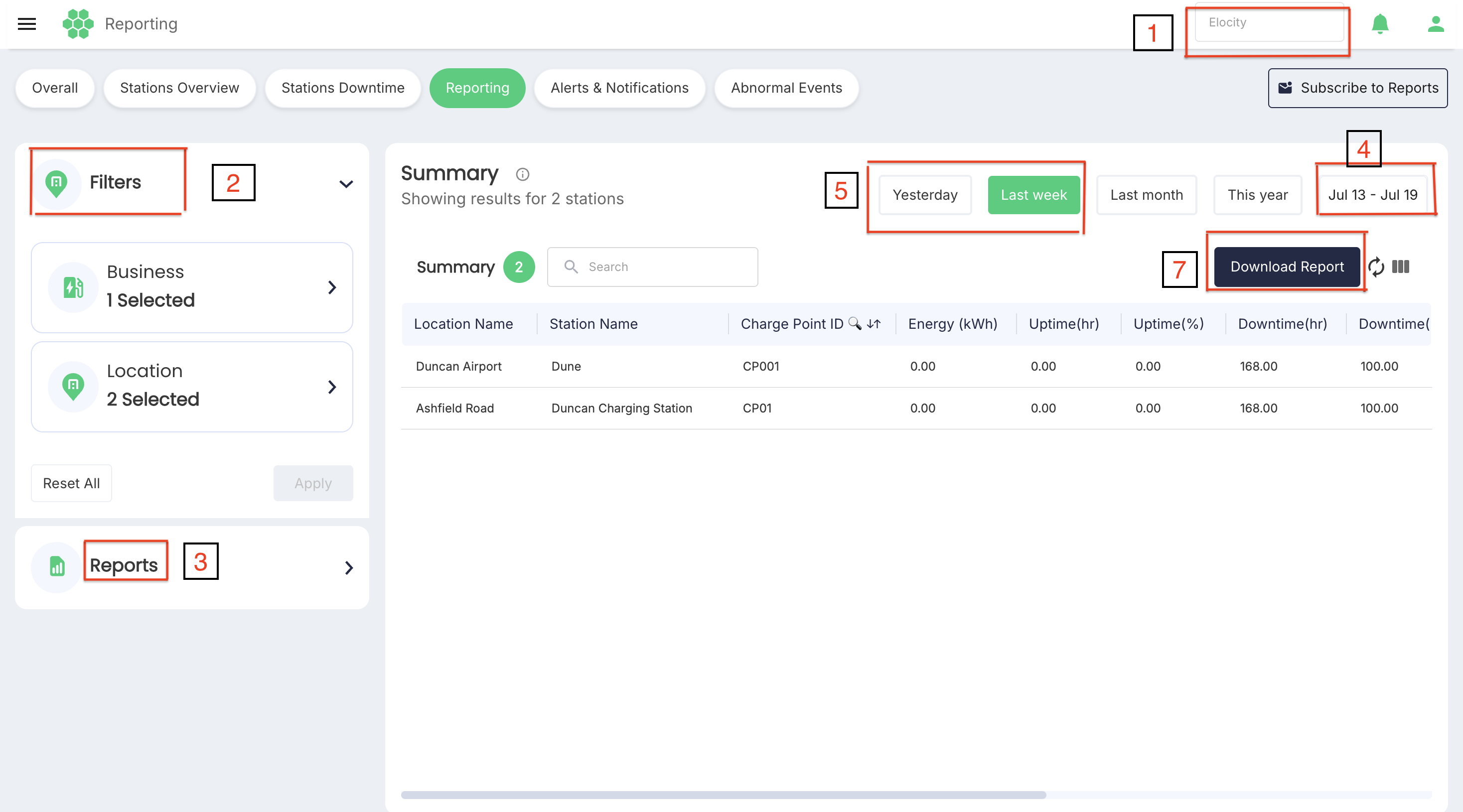
The Reporting module provides operational, financial, customer, availability, and charging-session reports for the EV charging network. Users can select a predefined report, limit its scope by business and location, choose a reporting period, review graphical or tabular results, and download detailed data in CSV format.
Authorized users can also subscribe to supported reports for scheduled delivery to their registered email address.
Report values depend on the selected business, locations, reporting period, and the user's access permissions. Apply the intended filters before interpreting or downloading results.
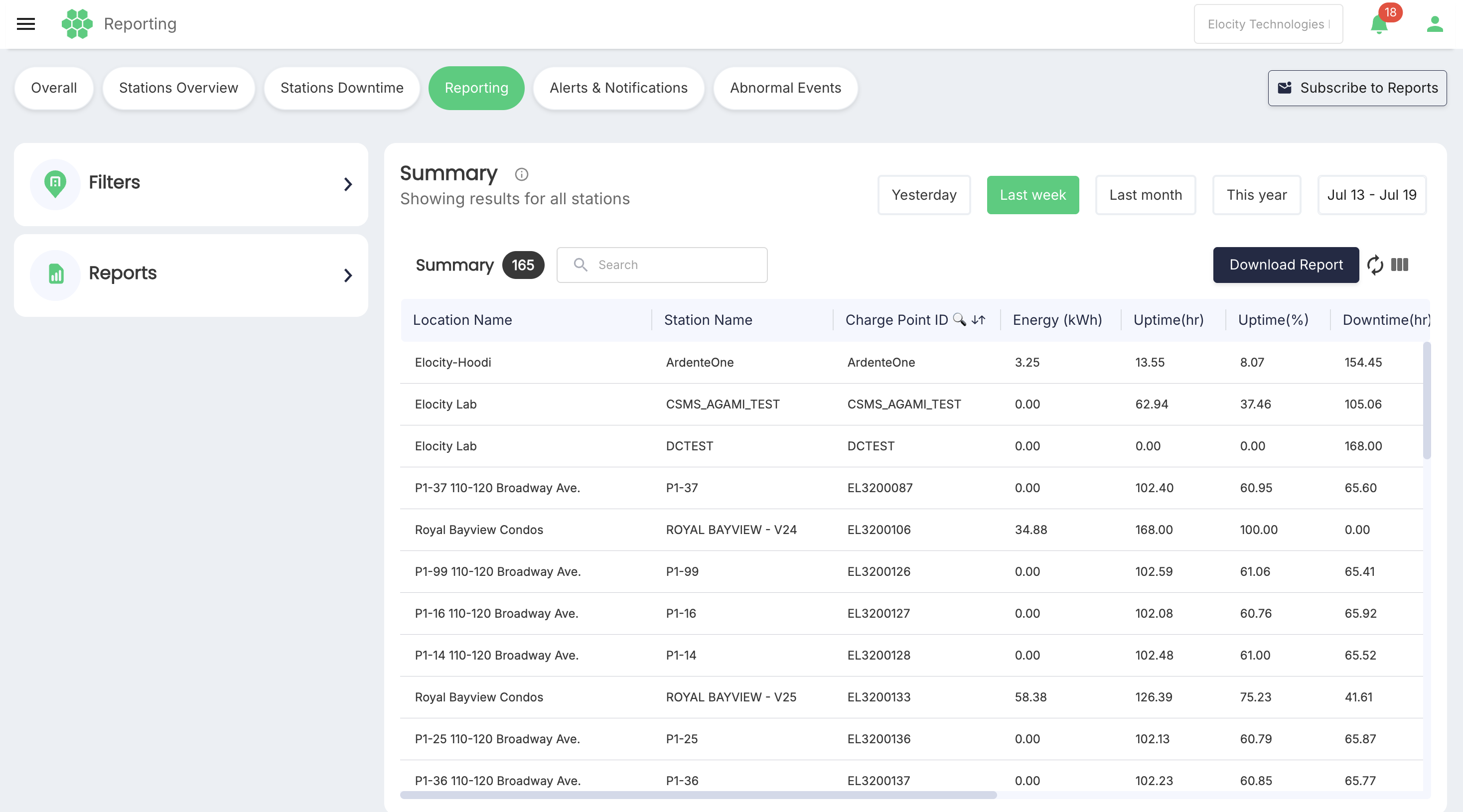
Accessing the module
- Sign in to the HIEV portal.
- Open Dashboard.
- Select Reporting.
The page contains two collapsible panels:
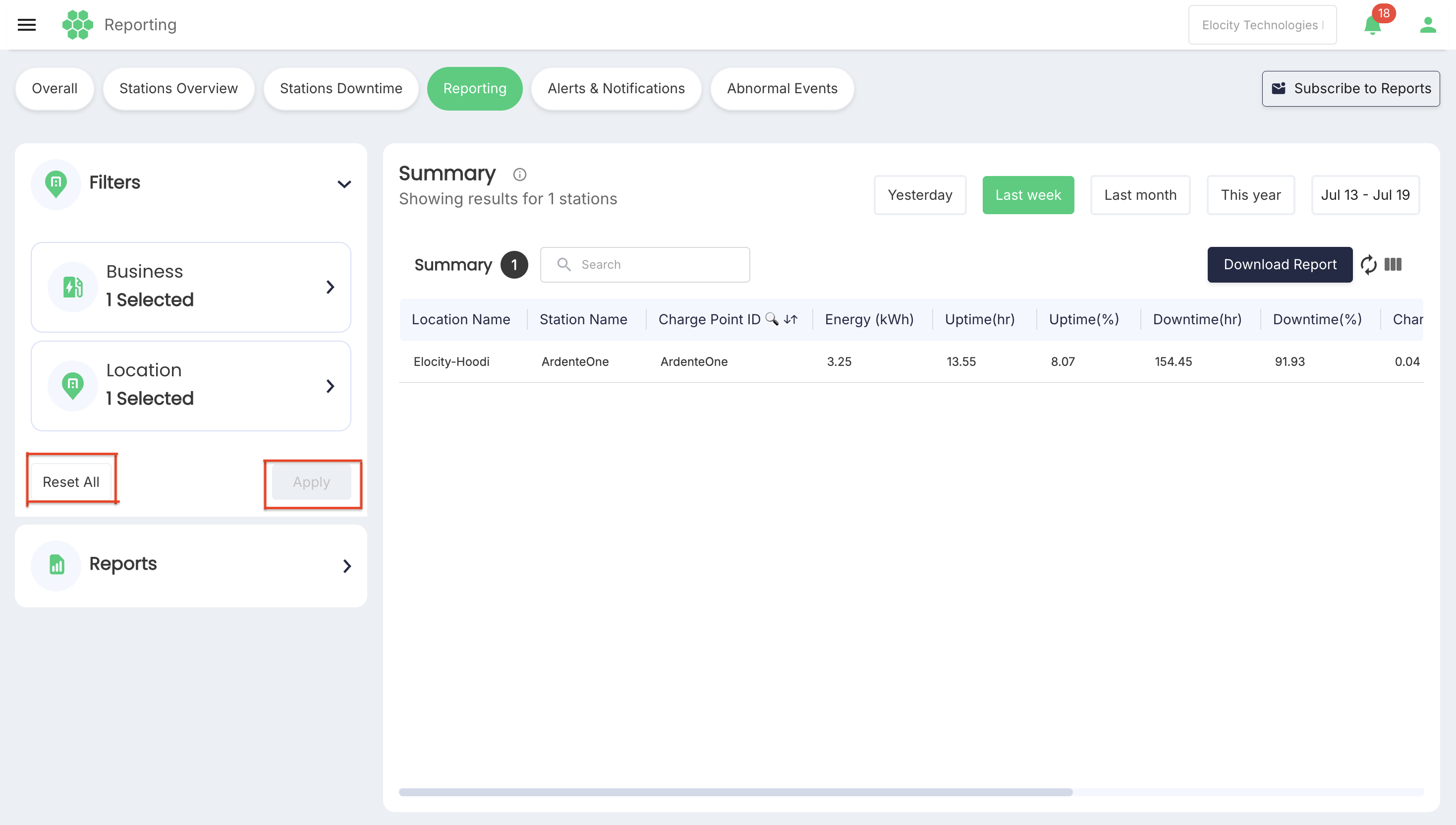
- Filters — Defines which businesses and locations are included.
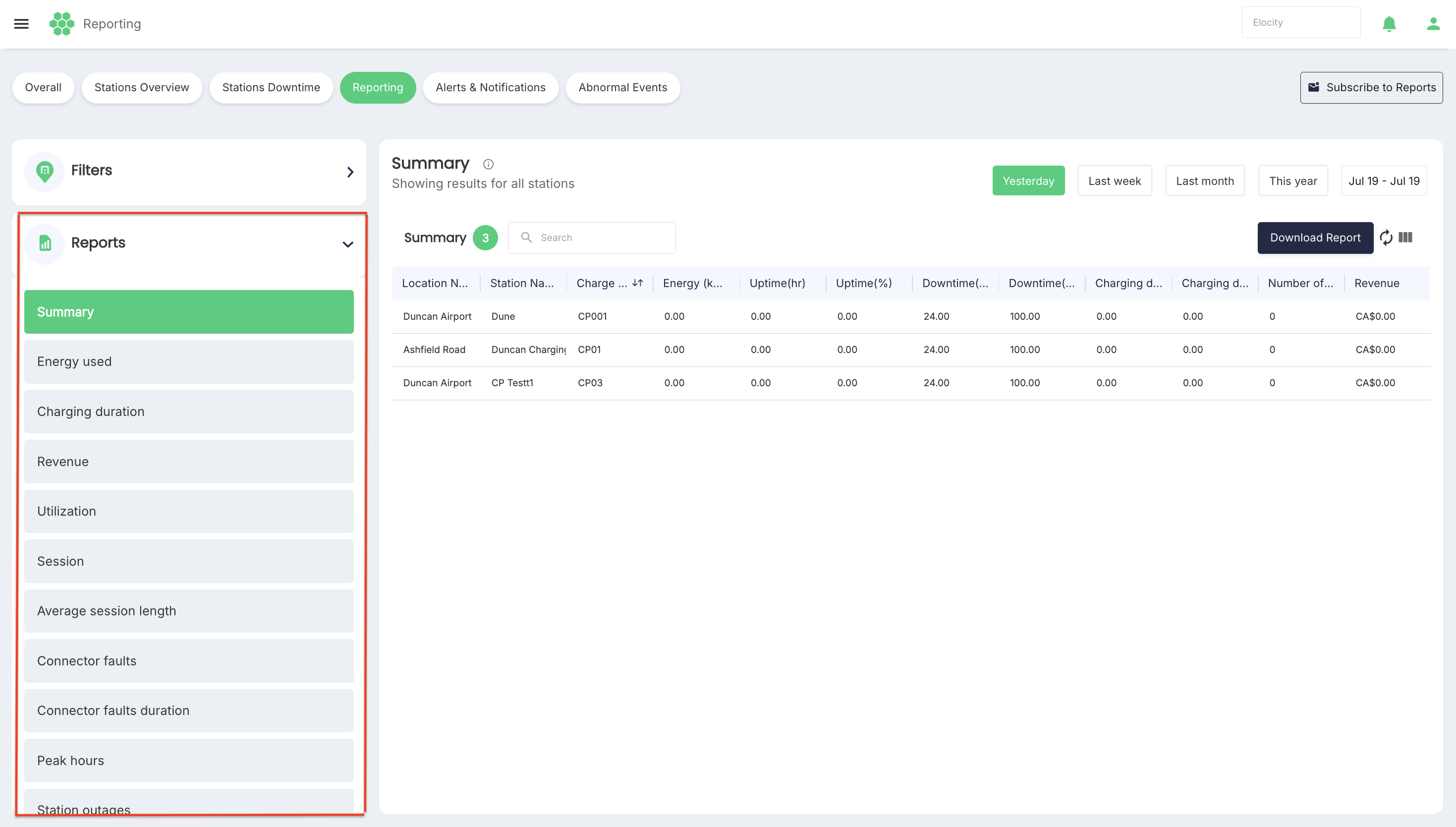
- Reports — Lists the available report types.
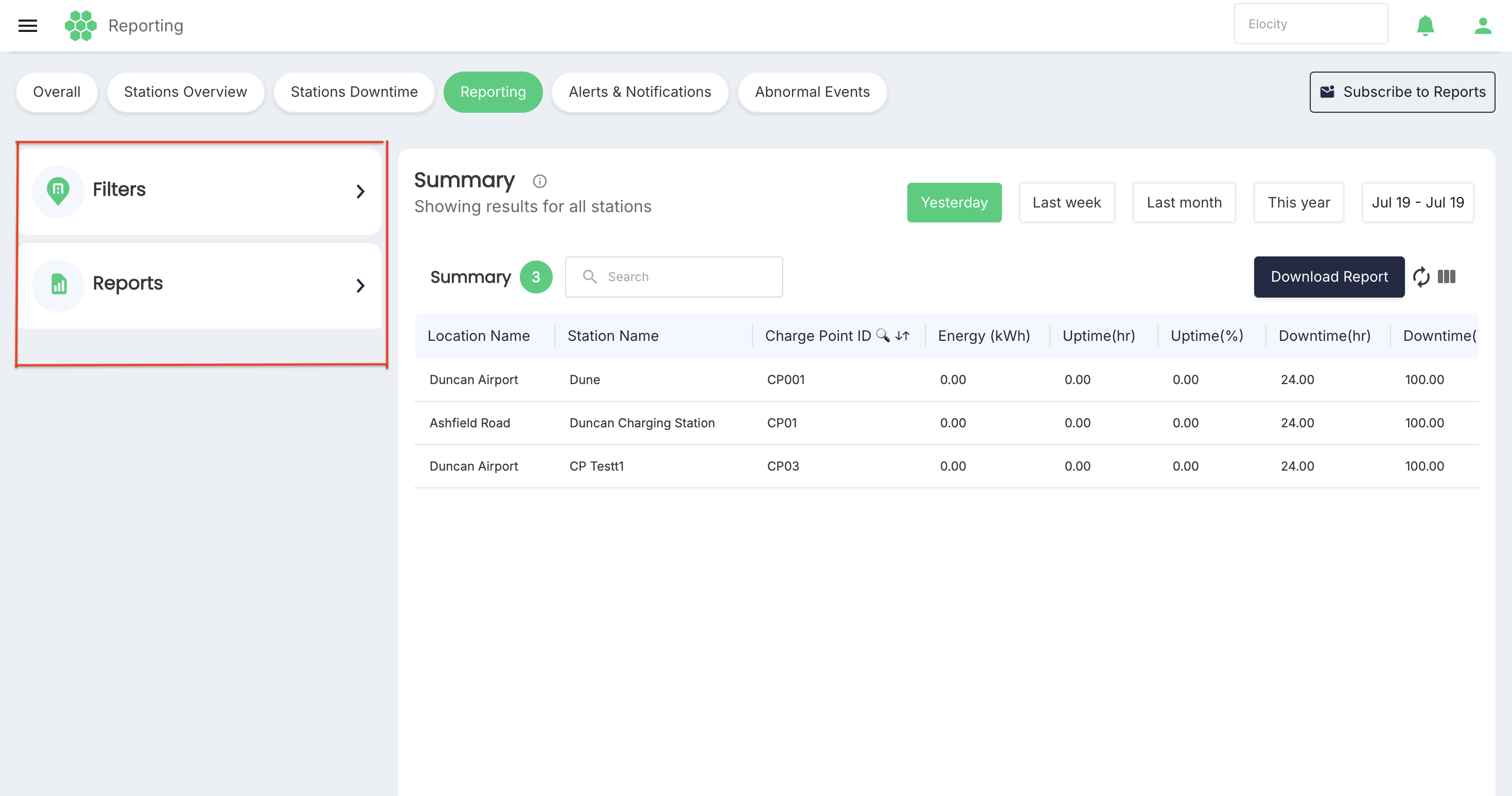
Business context and report filters
Header business selector
The business selector in the page header defines the overall organizational context available to the current user. Select All Businesses to work across all permitted businesses or choose a specific business context.
Business filter
Open Filters, then expand Business to select one or more businesses for the report.
Available controls include:
- Search businesses... — Locates a business by name.
- Select All — Selects every business available in the current context.
- Individual checkboxes — Include or exclude specific businesses.
- Selected counter — Shows how many businesses are currently selected.
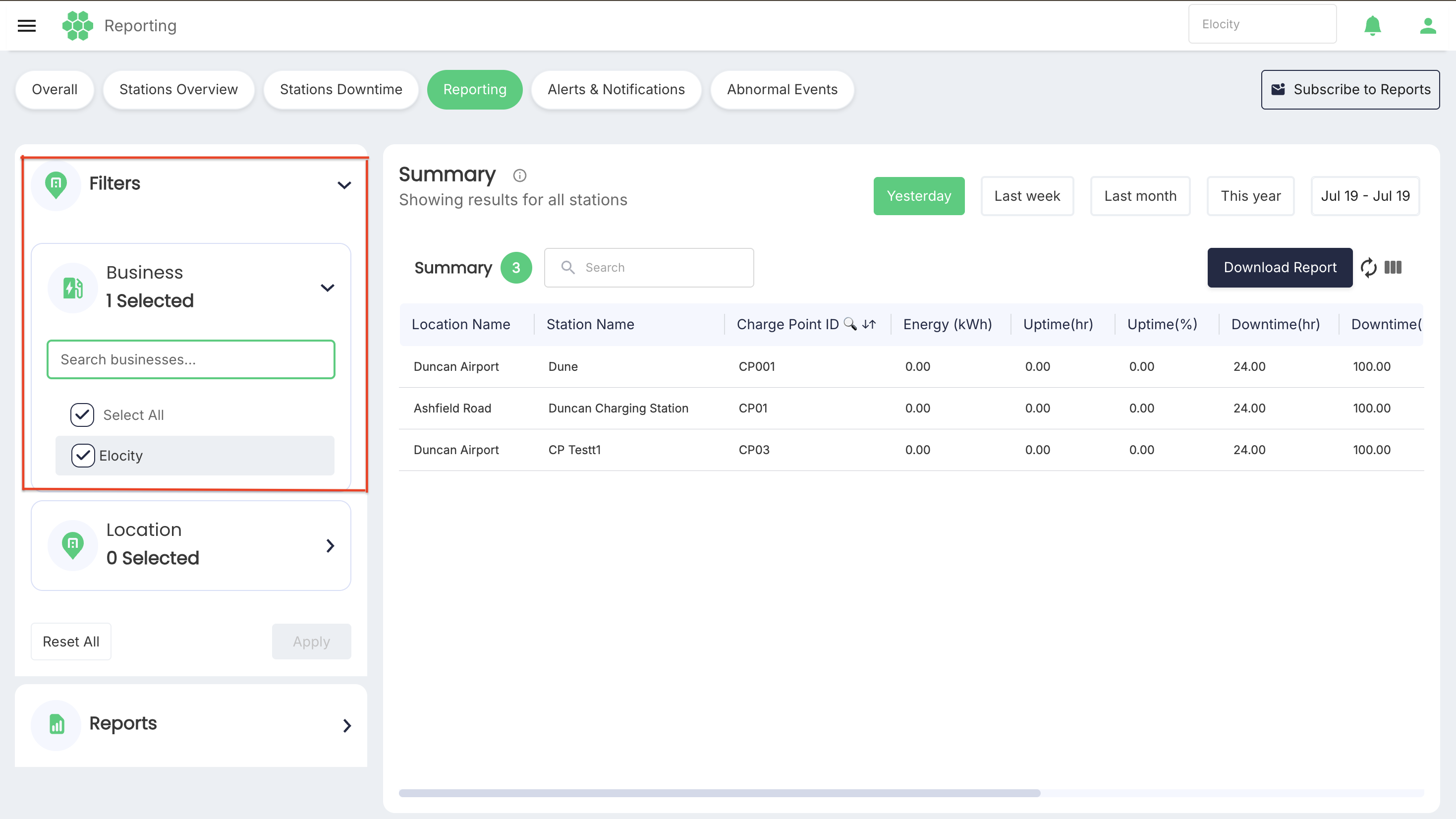
Location filter
Expand Location to select one or more locations. The location selector is hierarchical and can organize locations by region and city before displaying the individual locations.
Available controls include:
- Search Locations... — Locates matching location entries.
- Select All — Selects every available location.
- Toggle — Expands or collapses a region or city branch.
- Region, city, and location checkboxes — Select the required geographic scope.
- Selected counter — Shows how many location entries are selected.
For example, a region such as Ontario can be expanded to show cities, and a city can be expanded to reach its associated locations.
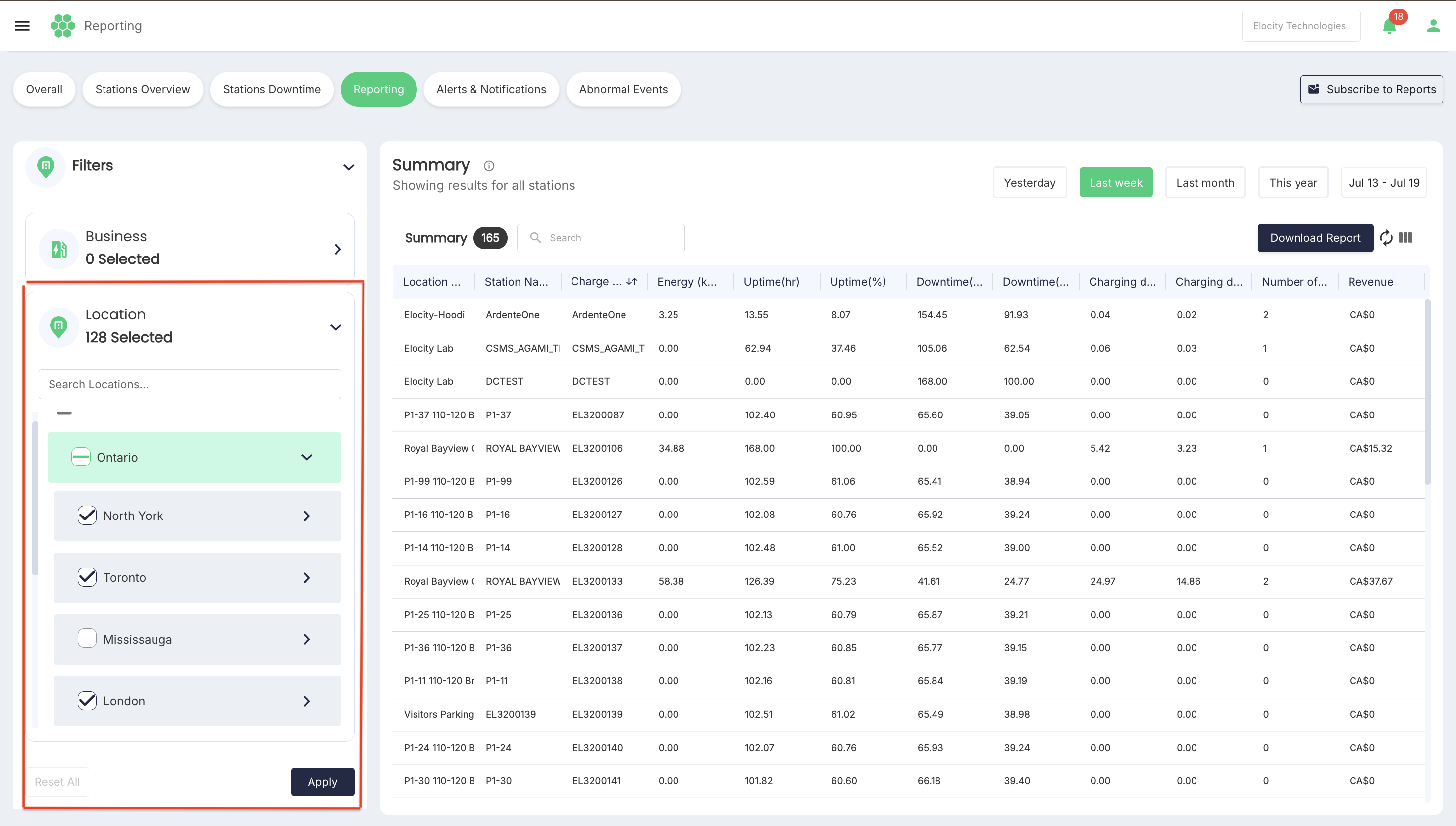
Applying or clearing filters
Select Apply in the Filters panel to update the active report. Select Reset All to remove the report-level business and location selections.
The message above the report, such as Showing results for all stations, confirms the current result scope.
Selecting a report
Open the Reports panel and select the required report name. The report area updates without leaving the Reporting page.
The current module provides the following reports:
| Report | Description |
|---|---|
| Summary | Provides a station-level overview of energy, uptime, downtime, charging duration, sessions, and revenue. |
| Energy used | Shows electrical energy delivered during the selected period and supports analysis of consumption trends. |
| Charging duration | Shows the cumulative time spent in charging sessions across the selected scope. |
| Revenue | Shows charging-session revenue over the selected period for financial and performance analysis. |
| Utilization | Shows charger usage relative to available capacity, helping identify highly used and underused assets. |
| Session | Shows the number of charging sessions over time. |
| Average session length | Shows the mean duration of charging sessions and supports analysis of driver charging behaviour. |
| Connector faults | Shows the number of recorded connector-fault events. |
| Connector faults duration | Shows how long connectors remained in fault conditions. |
| Peak hours | Identifies periods with the highest charging activity. |
| Station outages | Shows recorded station-unavailability events and supports analysis of outage patterns. |
| Station outages duration | Shows the duration of station outages and their effect on network availability. |
| Power users by revenue | Identifies drivers or customers contributing the most charging revenue. |
| Power users by sessions | Identifies drivers or customers with the highest number of charging sessions. |
| Power users by energy | Identifies drivers or customers with the highest energy consumption. |
| Revenue Vs Discounts | Compares charging revenue with discounts to assess the financial impact of discounting. |
| Coupon Vs Discounts | Compares coupon use with discount amounts to evaluate promotional activity. |
| Corporate Group based revenue | Shows revenue associated with corporate groups. |
| Corporate Group based sessions | Shows charging-session volume associated with corporate groups. |
| Corporate Group based discount | Shows discounts applied to corporate groups. |
| Coupon Vs Sessions | Compares coupon use with charging-session volume. |
| Revenue Vs Sessions | Compares revenue with the number of charging sessions. |
| Revenue Vs Charging duration | Compares revenue with total charging duration. |
| Utilization Vs Outages Vs Total availability | Compares time spent utilized, unavailable because of outages, and otherwise available. |
| Station availability | Shows station availability over the selected reporting period. |
| Unique drivers | Shows the number of distinct drivers using the selected charging network. |
| Station lifetime histogram | Displays a color-coded connector-status timeline for selected stations on a chosen date. |
| Charging Session | Provides transaction-level charging-session, customer, energy, cost, payment, and metering information. |
| Greenhouse Gas Used | Shows the estimated greenhouse gas emissions and cumulative emissions for EV charging over the selected reporting period. |
Time controls
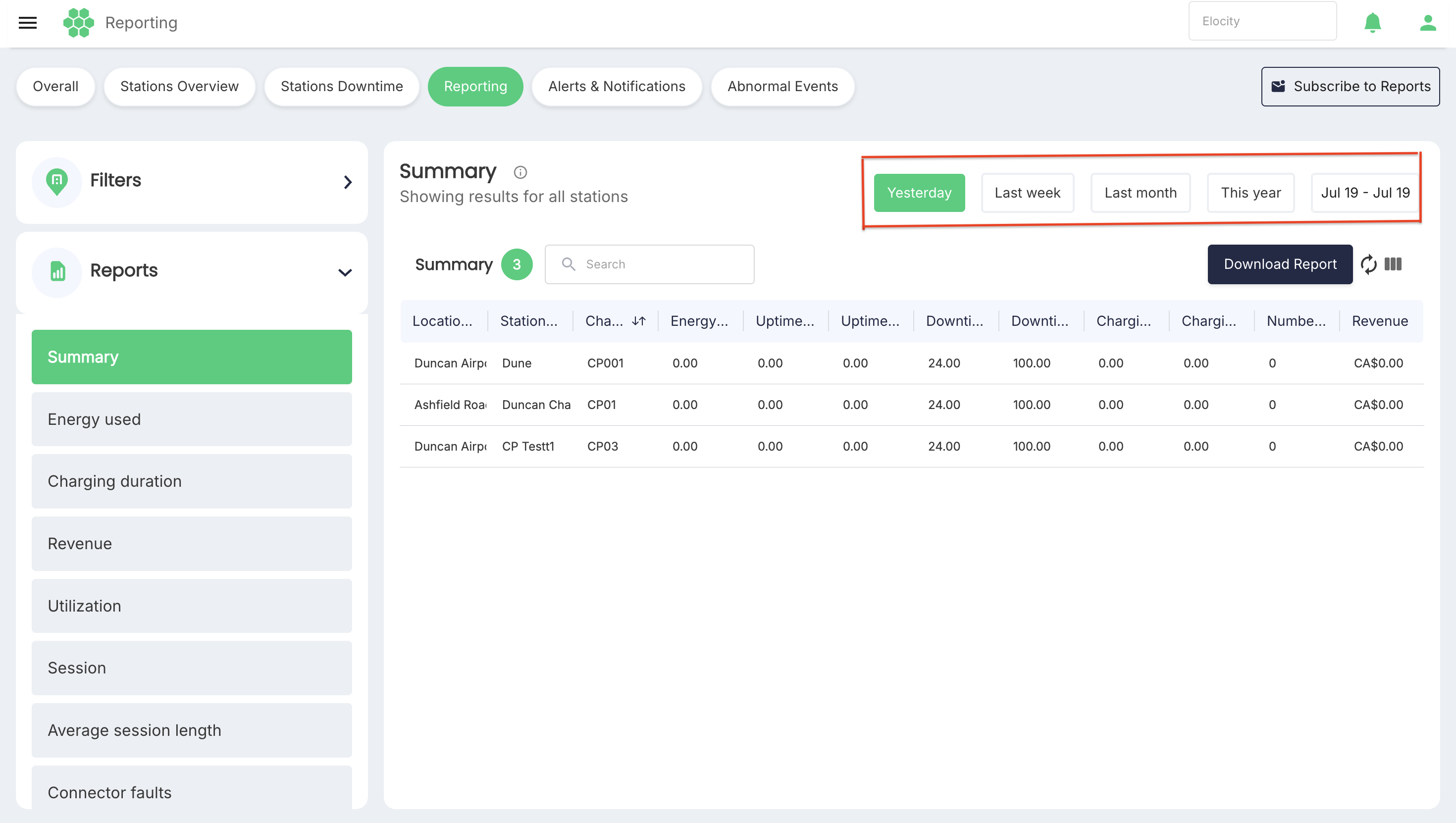
Most reports provide the following preset reporting periods:
- Yesterday
- Last week
- Last month
- This year
Select the displayed date range to choose a custom start and end date.
Where supported, use the aggregation selector to switch between:
- Day Based — Groups the result by day.
- Week Based — Groups the result by week.
Aggregation is not displayed for every report. Use it only when the selected report provides the control.
Graphical report controls
Most analytical reports display a chart. Depending on the report, the chart can include a cumulative series or a supporting data table.
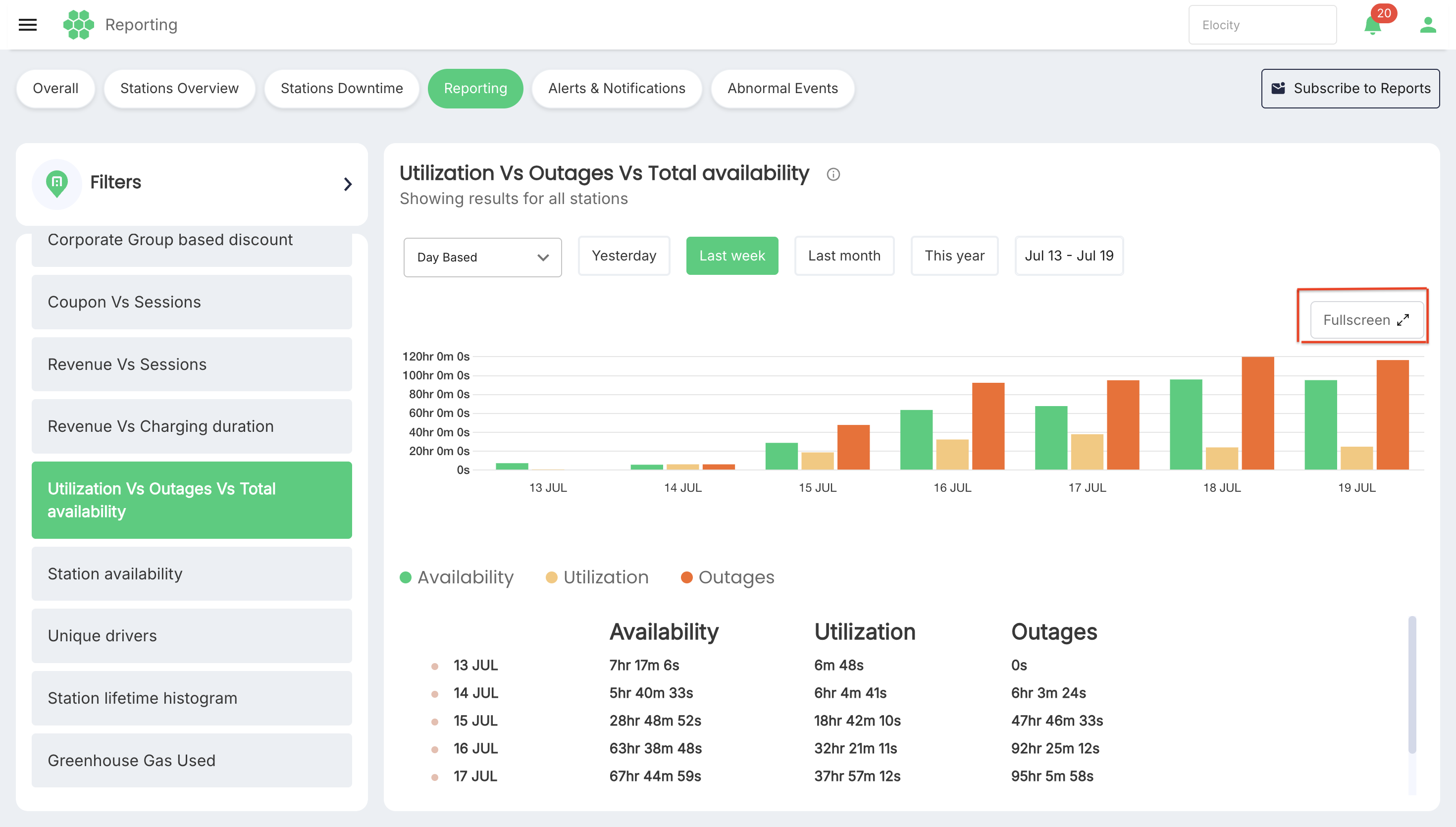
- Select Fullscreen to enlarge a chart for closer review.
- Use the legend to identify or compare the plotted measures.
- Hover over chart points or bars, where supported, to review the value for a specific period or category.
- Review the supporting table when the report provides one. For example, Utilization Vs Outages Vs Total availability displays Availability, Utilization, and Outages by period.
Use Download Report when the underlying detailed values are required; the CSV contains more granular information than the chart alone.
Summary report
The Summary report displays one record per station for the active scope and period. The Summary counter shows the number of returned station records.
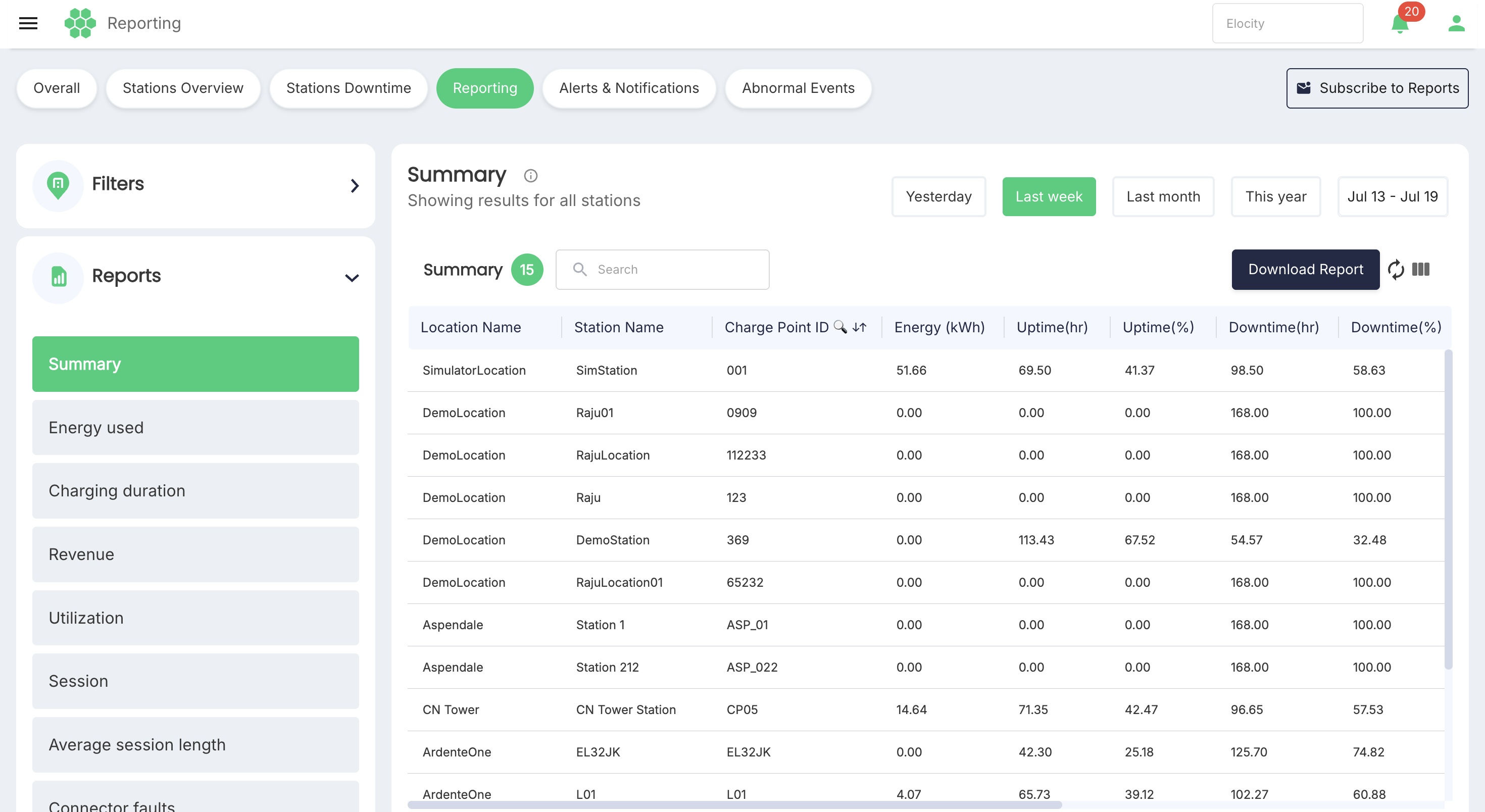
Summary columns
| Column | Description |
|---|---|
| Location Name | Location containing the station. |
| Station Name | Station display name. |
| Charge Point ID | Unique station identifier used by the charging platform. |
| Energy (kWh) | Energy delivered during the period. |
| Uptime (hr) | Recorded time the station was online or available, expressed in hours. |
| Uptime (%) | Uptime as a percentage of the applicable reporting period. |
| Downtime (hr) | Recorded station-disconnection or outage time in hours. |
| Downtime (%) | Downtime as a percentage of the applicable reporting period. |
| Charging duration (hr) | Total charging time in hours. |
| Charging duration (%) | Charging time as a percentage of the applicable reporting period. |
| Number of Sessions | Charging sessions recorded for the station. |
| Revenue | Charging revenue in the configured currency. |
Summary grid tools
- Search filters the displayed station records.
- Refresh retrieves the latest available results.
- Column Filter opens the Show / Hide Columns menu.
- Supported column headers can be used for sorting or column-level filtering.
- Download Report exports the selected Summary data in CSV format.
In the Column Filter menu, select or clear the required columns, then select Apply. Use Deselect All to clear all column selections.
Station lifetime histogram
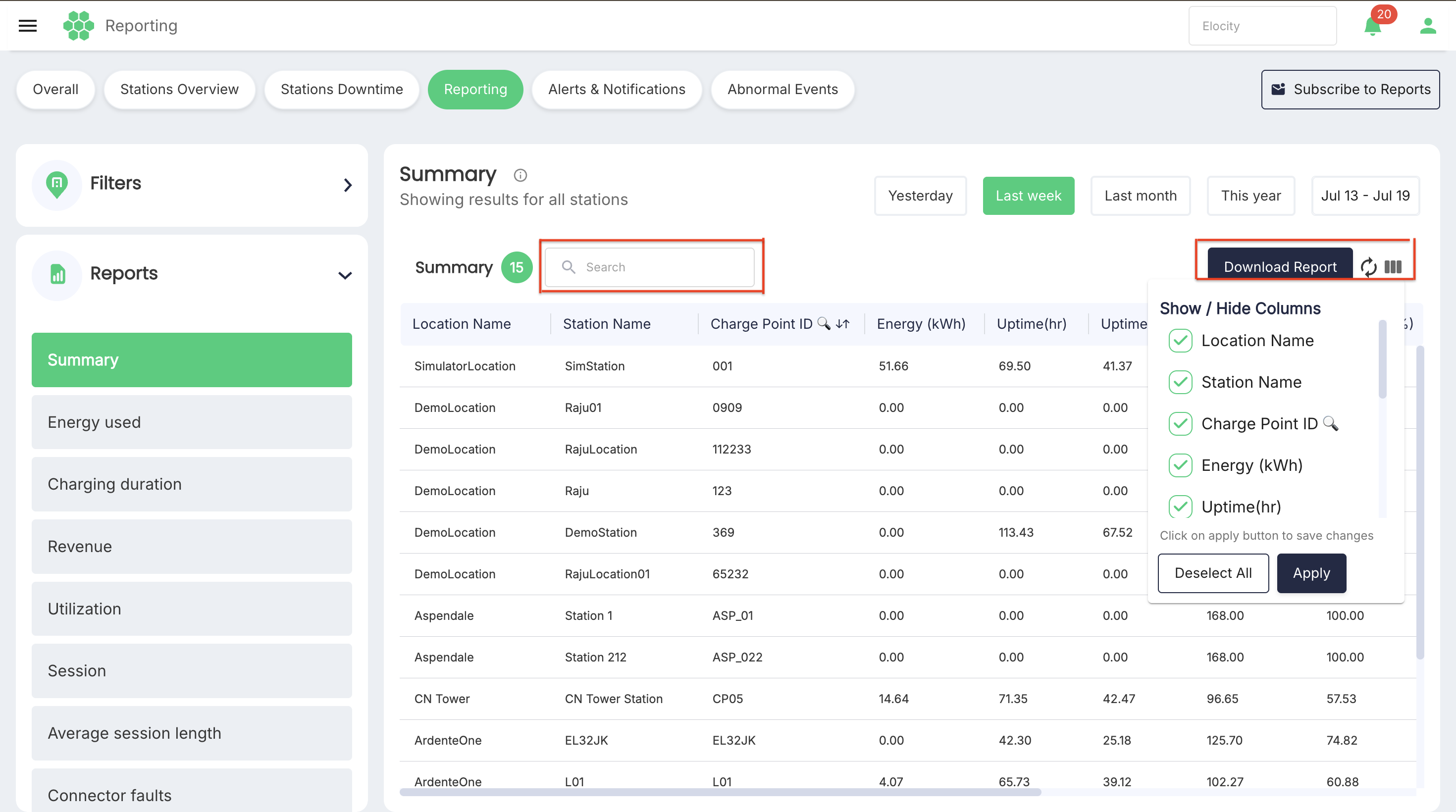
The Station lifetime histogram report has report-specific controls:
- Select Date — Chooses the date to analyze.
- All Chargers — Selects one or more stations. Options are displayed using the station name and Charge Point ID.
The report prompts the user to select station details before displaying the histogram. After a station is selected, the report presents a horizontal timeline for each connector sequence. The connector type and sequence number, such as SAE J1772 (Sequence 1), identify the timeline being displayed.
The timeline uses color-coded segments to show when the connector was in each supported state:
- Available
- Preparing
- Charging
- Finishing
- Unavailable
- Reserved
- Fault
- Suspended EVSE
- Suspended EV
- Unknown
Use the time axis to determine when a status began, how long it continued, and when the next status was recorded. Select Fullscreen to enlarge the visualization. If no matching data exists for the selected station and date, the page displays No Data Available.
This report does not use the standard multi-day report layout.
Charging Session report
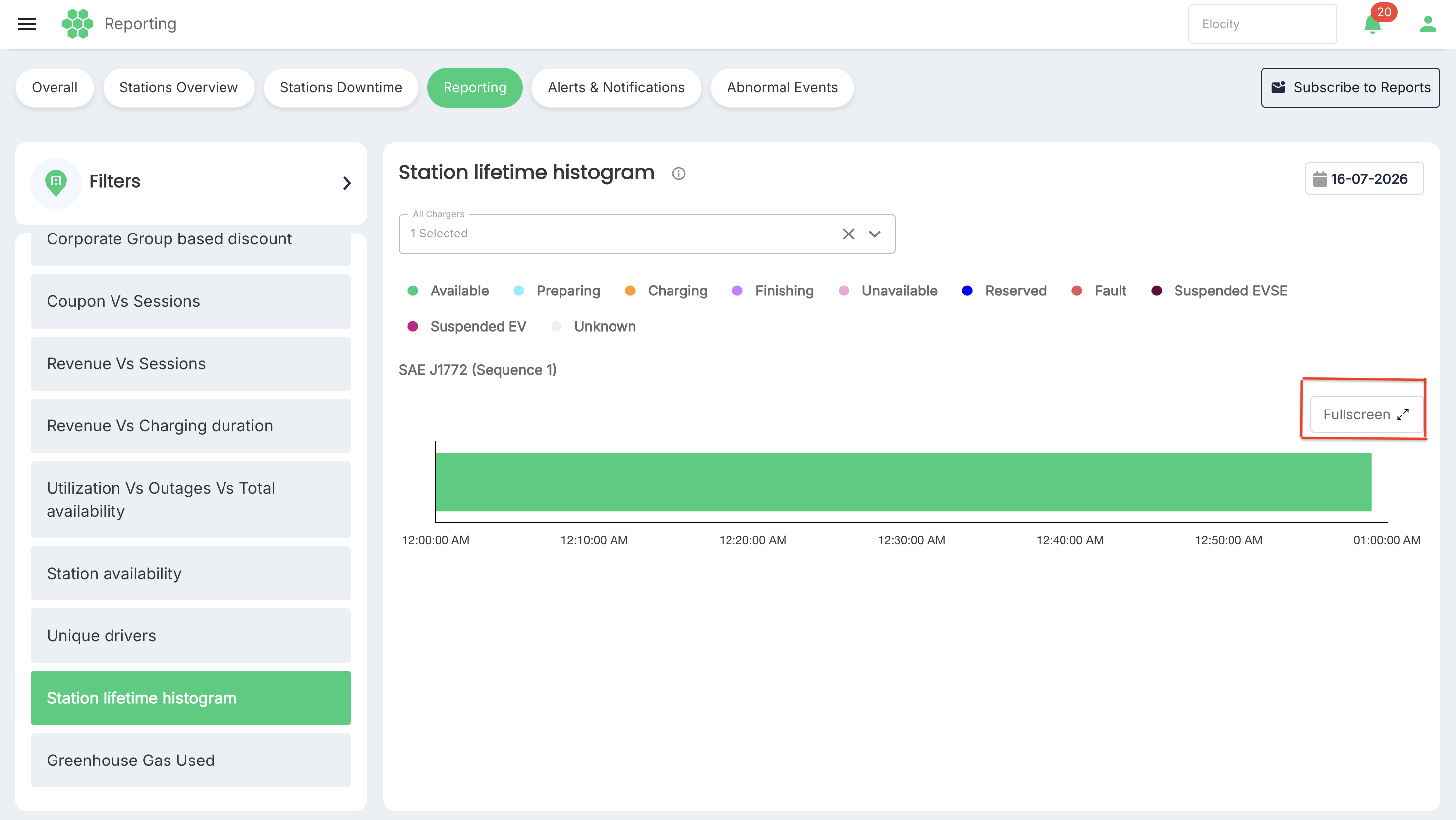
The Charging Session report provides one row per charging transaction for the selected reporting period. The Charging Sessions counter shows the number of returned records.
Charging Session grid tools
- Search filters the displayed sessions.
- Refresh requests the latest session data.
- Column Filter controls which session fields are displayed.
- Supported headers can be used for sorting or column-level filtering.
- Download Report exports the session data in CSV format.
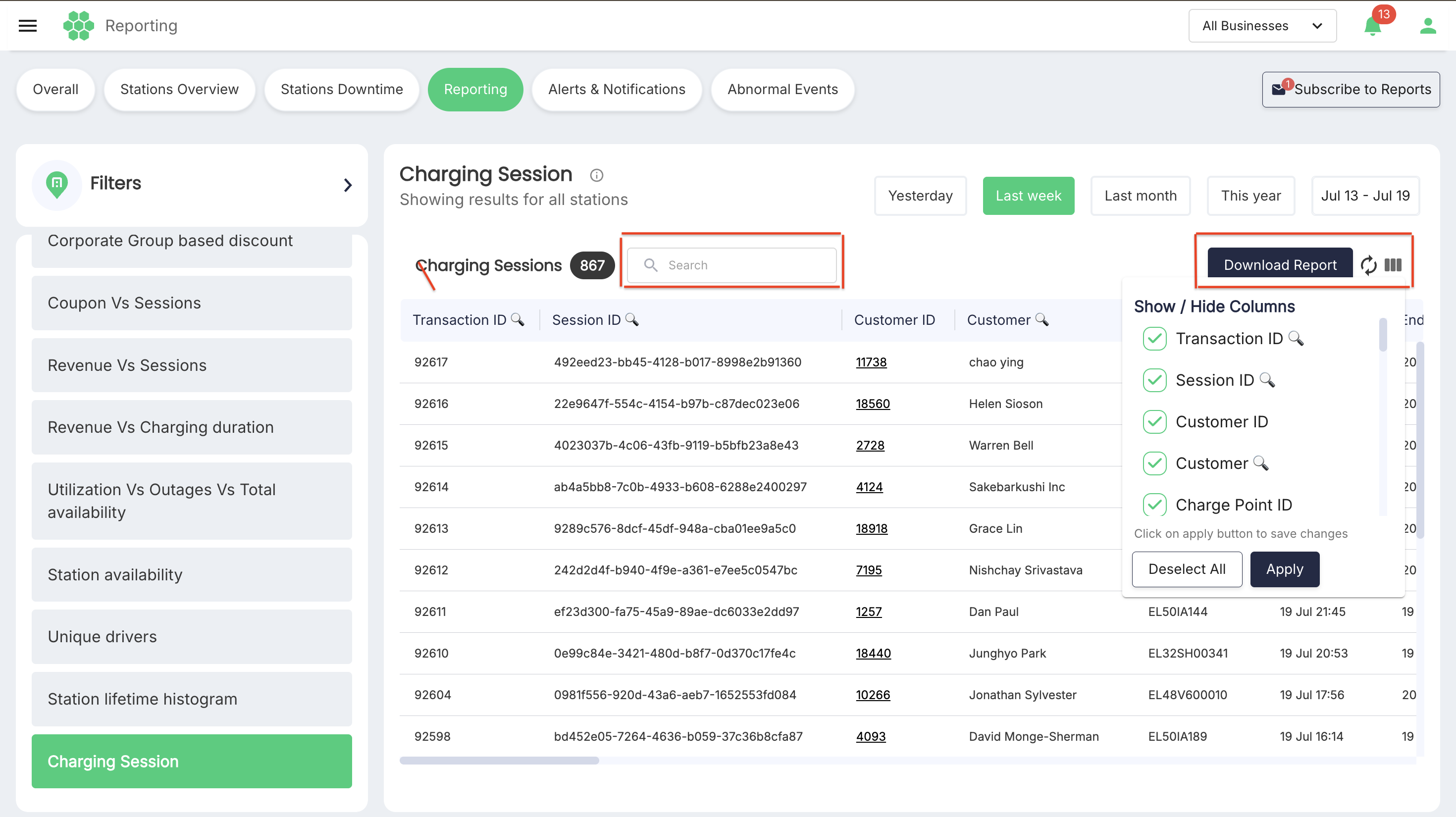
Available Charging Session columns
- Transaction ID — Platform transaction identifier.
- Session ID — Unique charging-session identifier.
- Customer ID — Platform identifier of the associated customer.
- Customer — Customer name.
- Charge Point ID — Station used for the transaction.
- Start Time and End Time — Session timestamps.
- Duration (dd:hh:mm:ss) — Total session duration.
- Start SoC (%) and End SoC (%) — Vehicle state of charge at the beginning and end, when reported.
- Location and Station — Charging site and station.
- Connector — Connector used for the session.
- Energy Consumed (kWh) — Energy delivered during the transaction.
- Cost — Final recorded session cost.
- Cost Before Discount — Cost before applying discounts.
- Discount — Discount applied to the session.
- Cost Round Off — Rounding adjustment applied to the cost.
- Transaction Status — Current or final transaction state.
- Payment Type and Payment Status — Payment method and processing state.
- Billing ID and Order ID — Billing and payment-order references.
- Payment Date — Recorded payment timestamp.
- Start meter Values and Stop meter Values — Meter readings associated with the session.
- Remark — Additional transaction information.
- Refunded Amount — Amount refunded, when applicable.
Select Column Filter to show or hide any of these fields. Select Apply within the menu to save the layout.
Searching, refreshing, and configuring grids
Tabular reports use a common set of tools:
- Enter text in Search to narrow the current rows.
- Select Refresh to obtain the latest available report data.
- Select Column Filter to customize visible columns.
- Use sortable headers to change the order of records.
- Use a column menu when a report provides a comparison or value filter.
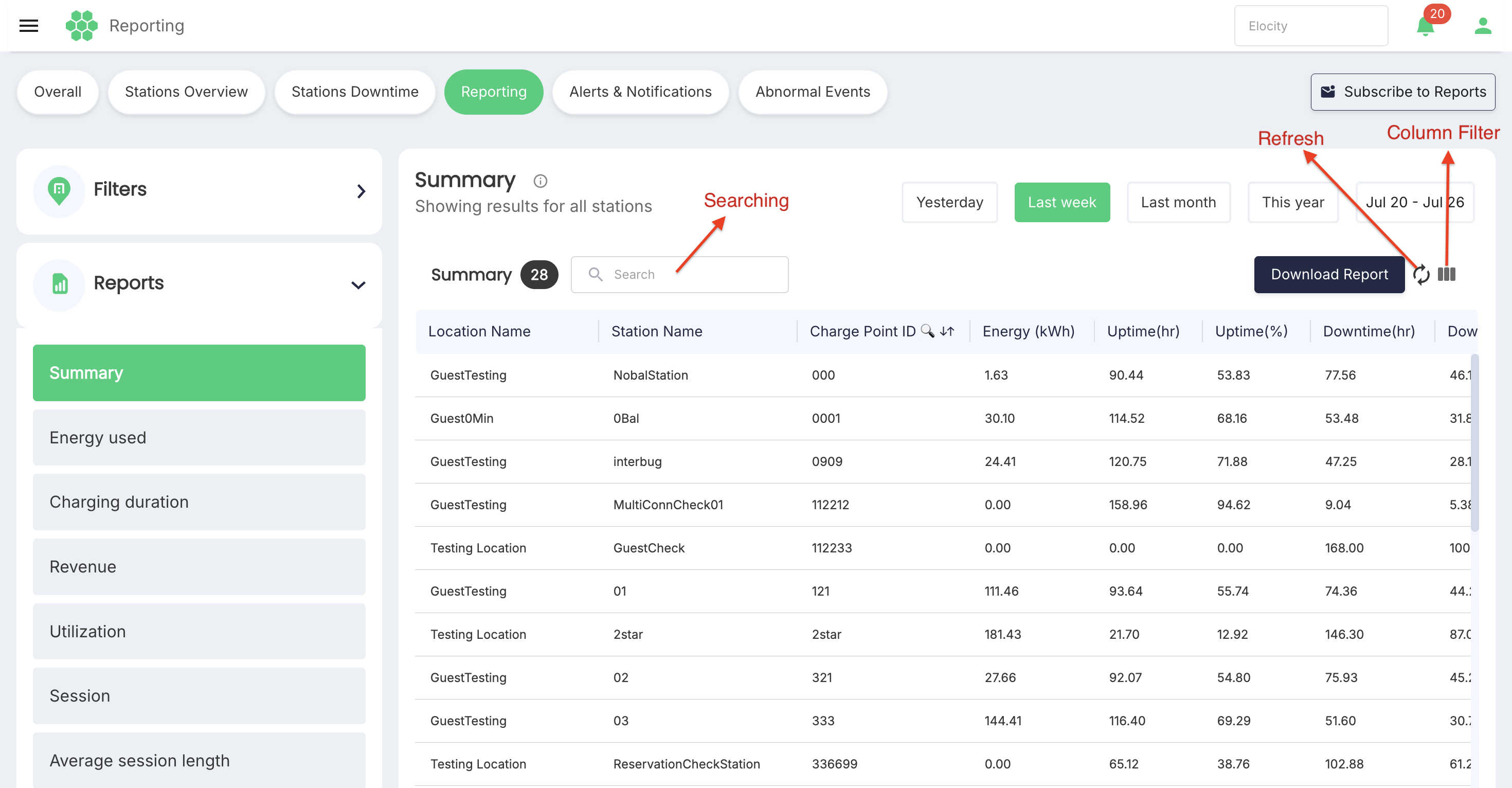
Search and column visibility affect the on-screen analysis. Before downloading, confirm the applied business, location, report, and date selections.
Downloading reports
Select Download Report to save the selected report in CSV format.
Recommended procedure:
- Select the correct business context.
- Apply the required Business and Location filters.
- Select the report.
- Choose the preset or custom reporting period.
- Select Day Based or Week Based aggregation when required and available.
- Review the displayed chart, counter, or grid.
- Select Download Report.
The CSV provides detailed values for offline analysis. Handle downloaded customer, financial, and charging-session data according to organizational privacy, retention, and sharing requirements.
Subscribing to reports
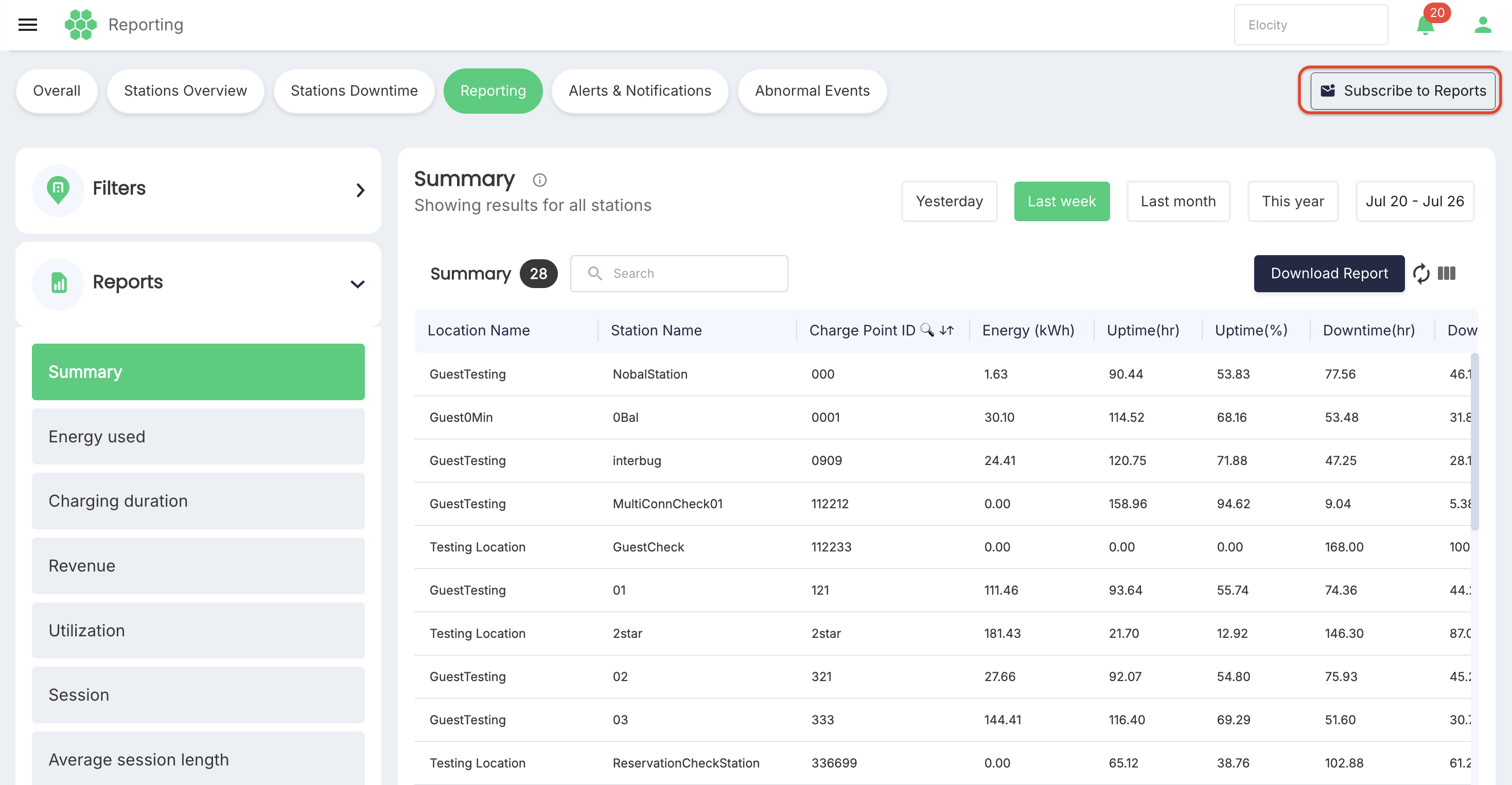
Select Subscribe to Reports to open the Report Subscription form. A subscription schedules supported report data for delivery to the user's registered email address.
The subscription uses the report time filter or date period applied on the Reporting screen when the subscription is created. Set the required report period before opening and saving the subscription.
Selecting reports
The form supports selecting multiple report types. Use Select All to select every report currently available for subscription.
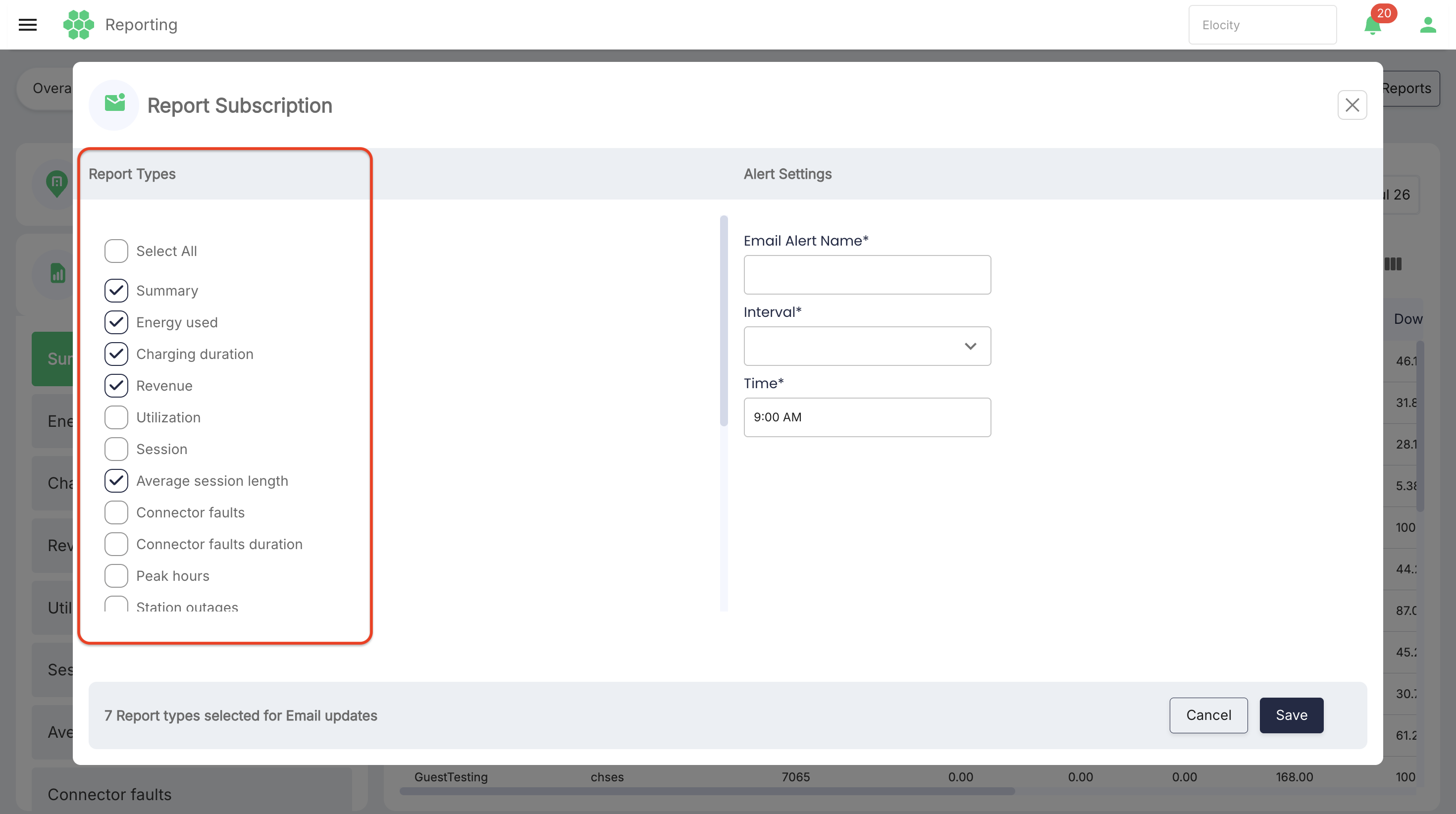 The current subscription form provides these reports:
- Summary
- Energy used
- Charging duration
- Revenue
- Utilization
- Session
- Average session length
- Connector faults
- Connector faults duration
- Peak hours
- Station outages
- Station outages duration
- Power users by revenue
- Power users by sessions
- Power users by energy
- Corporate Group based revenue
- Corporate Group based sessions
- Corporate Group based discount
- Station availability
- Unique drivers
- Station lifetime histogram
Comparison reports, Charging Session, and some other reports in the main selector are not offered in the current subscription form.
Alert settings
Complete the required fields marked with an asterisk:
- Email Alert Name — A descriptive name used to identify the subscription.
- Interval — Select Everyday, Every 2 Days, Every Week, or Every Month.
- Time — Select an hourly delivery time from 12:00 AM through 11:00 PM. The delivery schedule uses the browser's timezone.
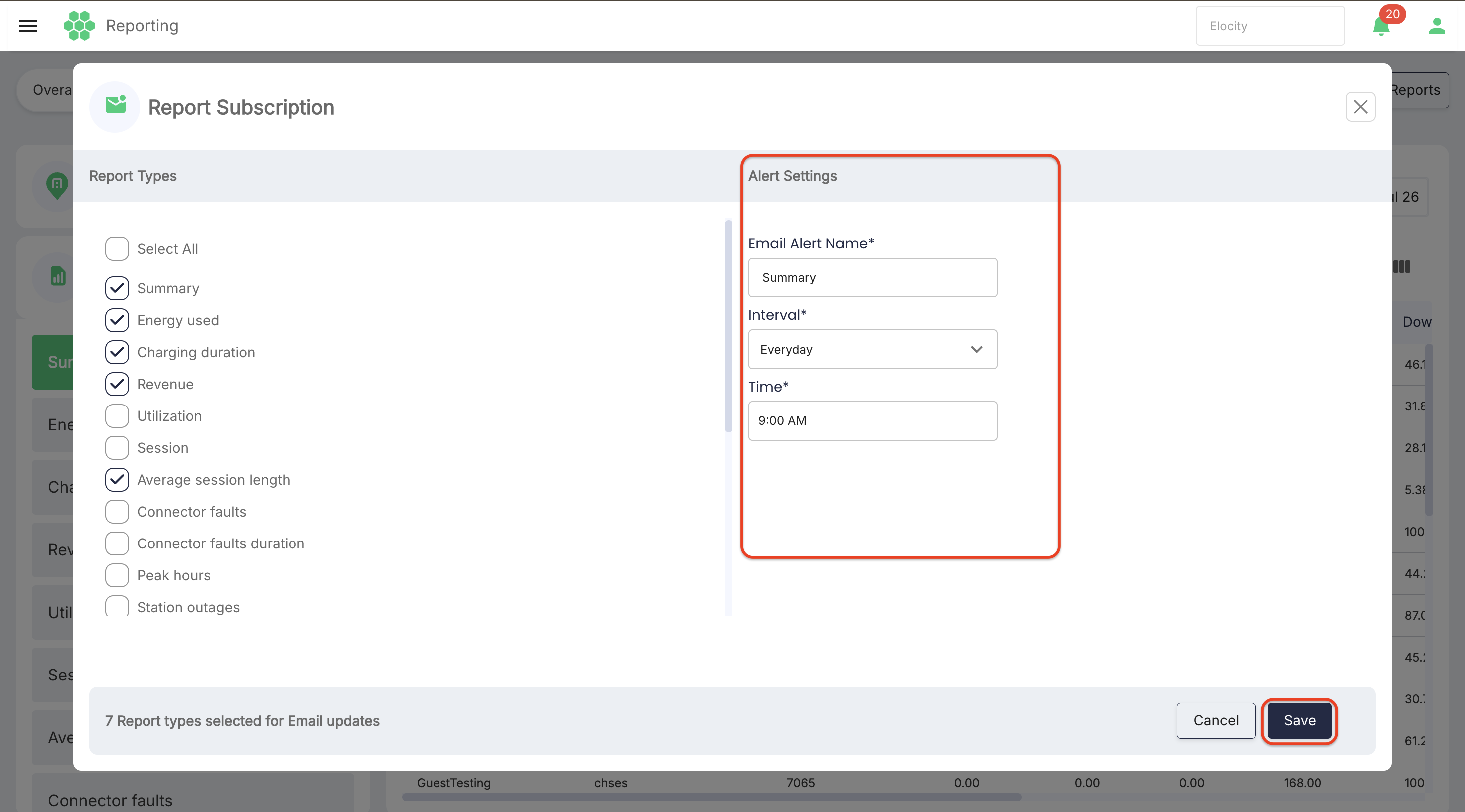
Select Save to create the subscription. Select Cancel to close the form without saving.
The form validates required fields. For example, an interval validation message is displayed when the Interval field is left empty.
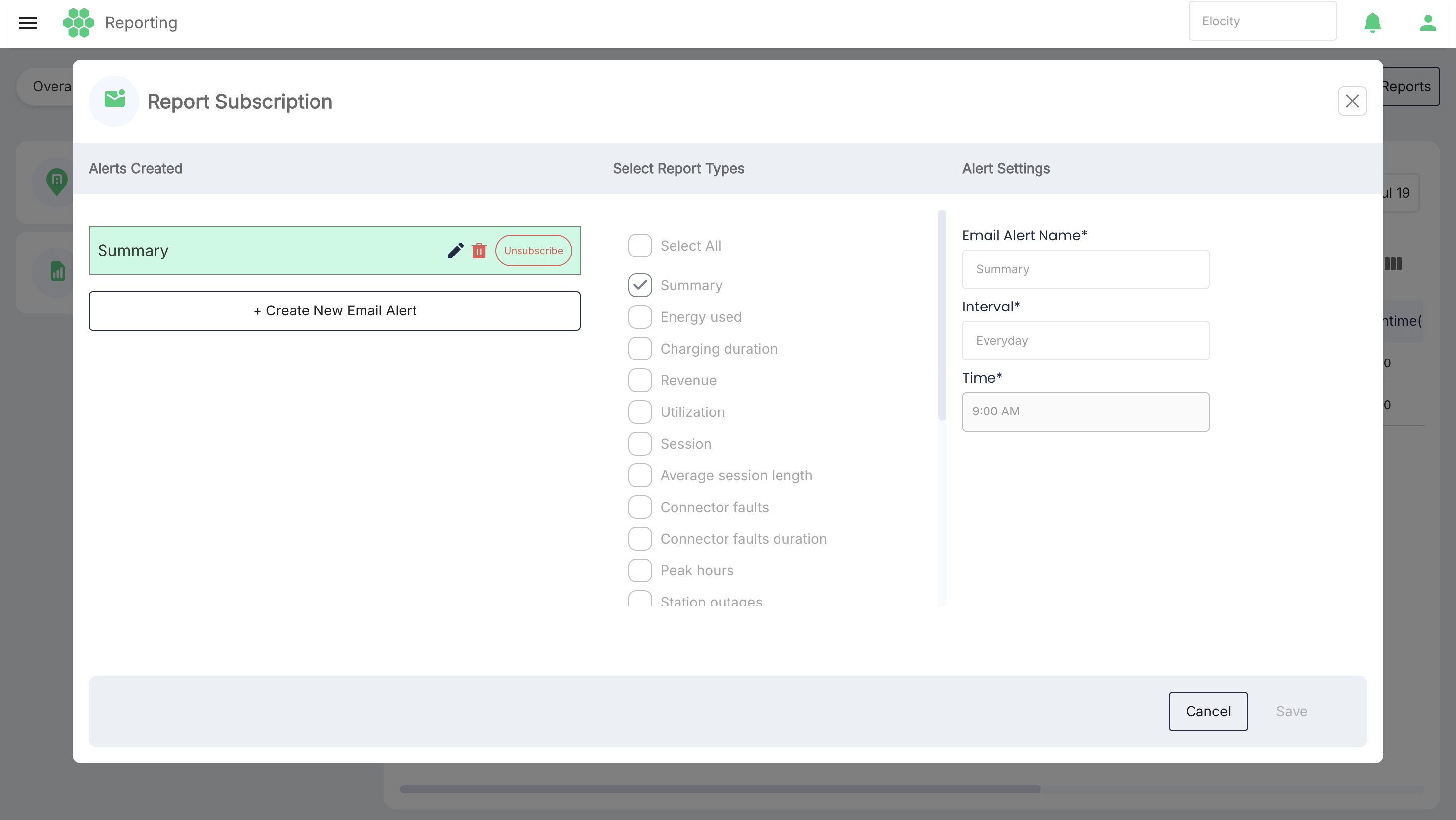
Managing existing subscriptions
After at least one subscription has been created, the Report Subscription screen displays an Alerts Created section.
- Select an existing alert to review its selected report types and alert settings.
- Select Unsubscribe to stop receiving that report subscription.
- Select + Create New Email Alert to create another subscription with the report types, interval, time, and captured reporting period required for the new alert.
- The alert card also displays edit and delete controls where those operations are available to the user.
When the report selection or schedule must be replaced, unsubscribe from the existing alert and create a new email alert with the required configuration.
Recommended reporting workflow
- Confirm the header business context.
- Open Filters and select the required businesses and locations.
- Select Apply.
- Open Reports and select the required report.
- Choose a preset or custom reporting period.
- Select Day Based or Week Based aggregation when available.
- Review the scope message and report output.
- Use Fullscreen, Search, sorting, or column controls as appropriate.
- Select Download Report when detailed CSV data is required.
- Use Subscribe to Reports when a supported report must be delivered on a recurring schedule.
Interpretation notes
- Different reports can use different units, aggregation levels, and available controls.
- A zero value means no matching activity was returned for that measure and scope; it does not prove the station has never recorded the activity.
- Customer, revenue, cost, payment, and refund fields can contain sensitive information.
- State-of-charge and meter values are available only when supplied by the charging station or related transaction data.
- Uptime, downtime, availability, utilization, and outage measures should be interpreted according to the platform's operational definitions.
- Totals can differ between users because of business assignments and permissions.